Monday, April 11, 2005

Travels to the Foothills of the Hilmalayas - March 28th to April 2nd, 2005

(see the photos under links in the right hand column - New Nanital, India)

We went away for the cousins half term to a place called Jeolikote near Nanital which is 320 klms due east of Delhi in the state of Untaranchal in the foothills. We chose this place simply by choosing the only place where we could actually speak to the proprietor and determine their level of hospitality. The lady I spoke to at the Cottage, Bhuvan Kumari, was exceptionally welcoming and seemed to be keen to host a couple of British families with lots of boy offspring. So we chose to go there.

We had booked some train tickets to travel to Kathgodam at the very base of the foothills. But when I was boasting about how cheap they were (£7 for a family of four to travel 320 klms over a six hour journey) someone suggested I check which class of ticket I had. When I did this I discovered that it was "cattle class". Several people in the know said it would be impossible for us to survive this level is discomfort for six hours with 2 children. Although Julie and I were willing to give it go just for the heck of it (and to prove a few people wrong) we finally gave in to their advice and joined the others (less my sister) who were going to travel down with Shashi in the car.
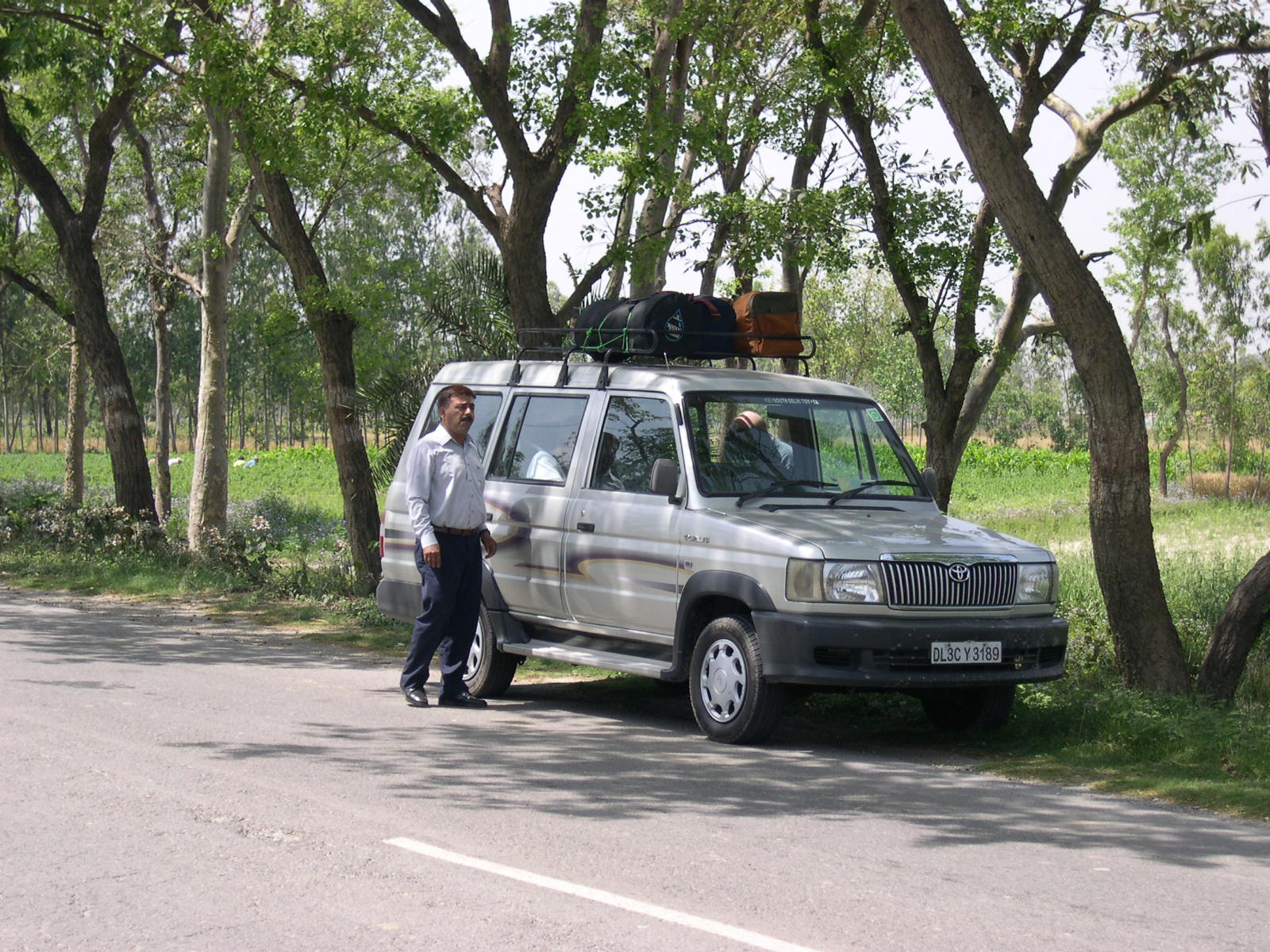


So the 7 of us and Shashi took off for the hills on Monday 28th March. The journey was surprisingly easy with 4 boys in the car for 6 and half hours. Perhaps the only time we have been grateful for Gameboys. Sammy spent alot of the time listening to the iPod. It now has 1,000 tunes on it and a loads of story tapes.

We were pleasantly surprised by the place when we arrived. The journey up the mountains (we were staying at an altitute of 4,250 feet) was very reminiscent of the south of france with one exception; the indian drivers were far worse than the french. Imagine that on blind hair pin bends? The mountains had many of the same structures and colours to those that we so dearly love in France.

The temperature started to drop as well. When we arrived the temperature was probably 15 deg C lower than what we had come to expect in New Delhi. Frankly, it was a welcome relief. In the evenings as we sat on the balcony, we even needed to put on a light jumper to ward off the chill in the air.


The accommodations were fine except for the beds which were wooden planks with a blanket on them. We were dreading the possibility of uncomfortable nights but somehow we had become quite used to hard beds at my sister's house and we all seemed to sleep well. The Cottage was built at least a 100 years ago and although it was a bit rickety, for what we have come to know of India, it was top class. The food was also excellent (after we had told them please to use no salt for us) and they cooked indian and western style food every night for us and the kids. Breakfast was omlettes or eggs and toast and cereals. We were well catered for.

This is what we did whilst we were there:

Monday: Drove to Jeolikote and established ourselves in the accommodation. We then took a walk up the hill and discovered an amazing Catholic Mission on the top of the hill. It was a girls school with 120 boarders and 500 day pupils. Many of the boarding pupils were taken in from local villages from parents who could no longer afford to look after or educate their children. Others were fee paying. The fees for day pupils were 70 to 100 rupees per month (£1 to £1.50 yes that is correct) - to encourage the poor to put their children in school. The fees for boarders ranged from nothing to 7,000 rupees per year (£85) depending on the individual's circumstances.

We met with one of the sisters who told us a lot about the school and invited us to come back to meet the Mother Superior any afternoon after 3:00 pm which we assured her we would endeavor to do.


Tuesday: We drove further up the mountain to the town of Nanital which is nestled by the side of a 3 klm lake and is at an altitude of 4,800 feet. It is a popular Indian holiday destination and it was rather like an Indian version of Brighton Beach but with a certain charm from another era. We literally bumped into a herd (yes we looked it up; it is herd) of horses. About 15 in total that had just deposited their riders and were looking for fresh customers.


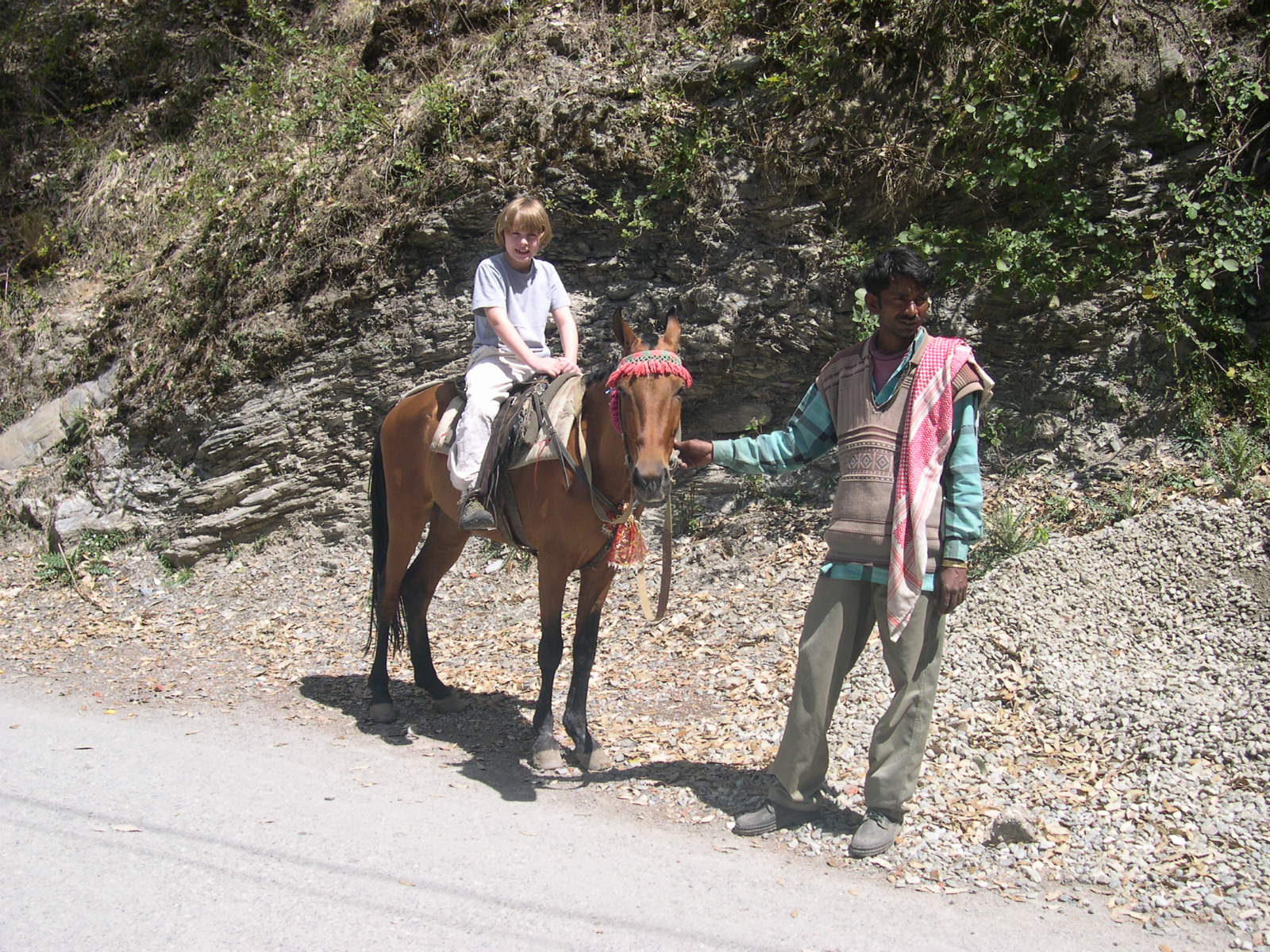
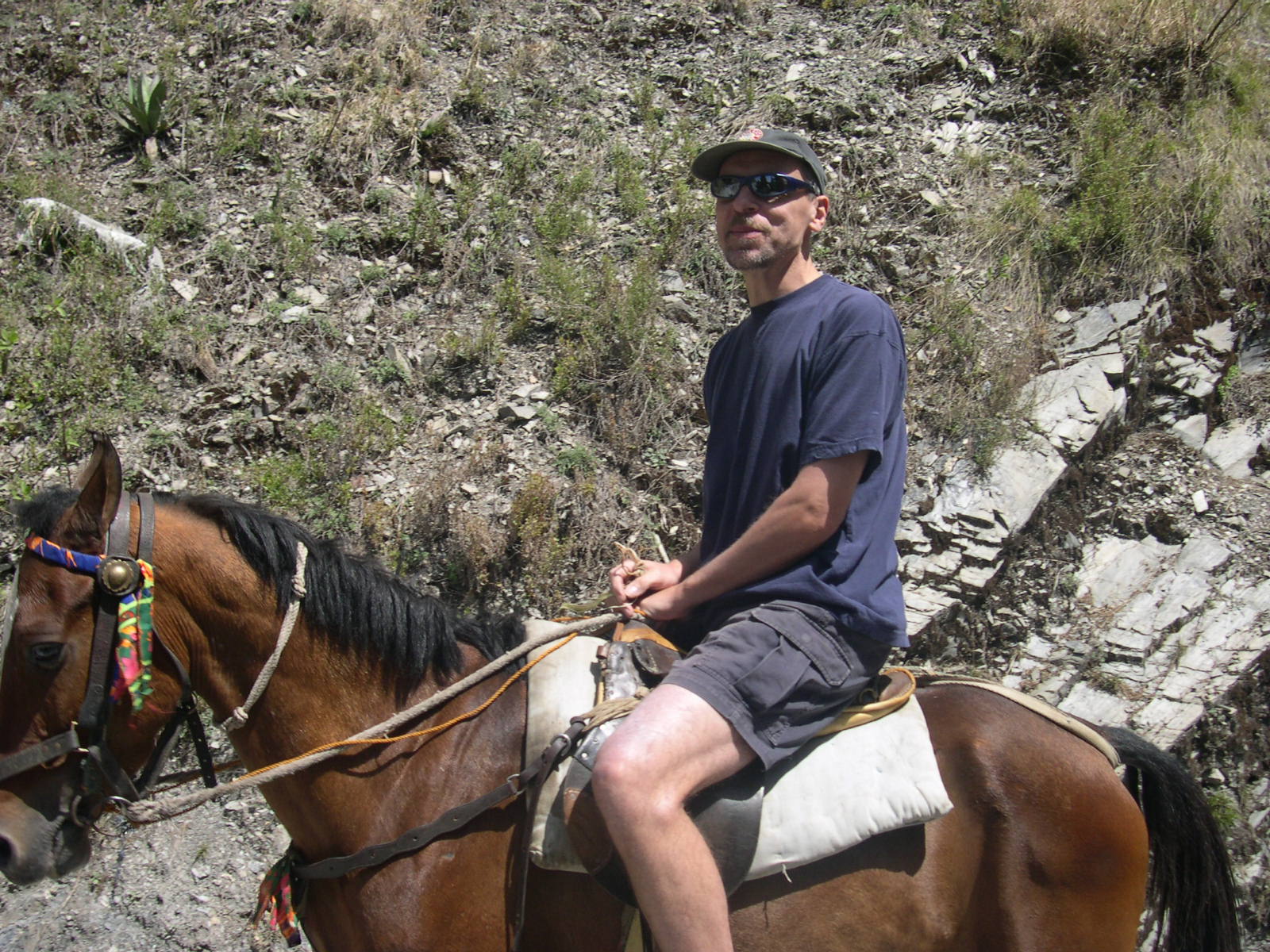
The horses were with their owners (boys) and as soon as we got out of the car they were all over us trying to physically put us on their horse (rather than their mates). There was lots of screaming and shouting as we chose the horses we wanted and negotiated through Shashi to get a good deal. We finally managed it and we all (except Julie and Rob) set off up the mountain on our steeds. See the photo further along in the blog or click on the New Nanital, India link on the top right side of the blog.

It was in the deep end as far as learning to ride was concerned. We had 5 horses and they come with four men (really boys) handlers. The handlers led the horses on foot but this does not mean you get an easy ride. These horses climbed up steep rugged paths that were barely suitable for a mountain goat. Now we understood why we needed the handlers. It was not for the fainthearted as the horses found it difficult getting their footings and the riders found it difficult not to be scared about falling over one of the sheer drops that we were riding right next to.

We made it to the top and Julie, Rob and our driver Shashi walked up and got to the top sometime later. I told Julie not to struggle to keep going after we saw the mountainous task that was before us but there is just no keeping her down. The view from the top was glorious but unfortunately there were no views of the snow capped Himalayas as it was far too hazy.



In the evening I discovered a glow worm in the garden of the Cottage after thinking it was a burning cigarette. It was very bright and had twin lamps on the back end.

Wednesday: After having missed her original train at 6:00 am from New Dehli (she was doing a re-enactment of our run to the station when we went to Agra) Suzanne caught a later train and arrived in Moradabad at 12:00 noon. We had sent Shashi to collect her (as she couldn't get a train directly to Kathgodam) and she arrived at Jeolikote at 3:00 pm.

We all took off for a walk across the valley, meeting an incredible number of people. Many of whom would stop their scooters or come directly up to us and engage in conversation. We were even invited back to a teachers house for tea. We politely declined. The boys got a ride on a scooter and spotted children bathing in the stream along the valley bottom. We saw people carrying all sorts of things on their heads and walking barefoot up the winding mountain paths.

After we got back we took the 2 boys to a little barbers shop up the mountain and much to the delight of the local girls, they had their blond hair chopped off.


Thursday: We all took off back up the mountain in the car and headed for Government House. In the summer all of the government of India (and in this case the governor of the local states) headed up into the hills to escape the oppressive heat on the plains. There was a time when the whole of the government of India could be accommodated on 4 rail carriages for this annual exodus.

The house we went to visit was completed by the British around 1915 and is the grandest building I have seen in India. Unfortunately no photographs were allowed, as it is still used for official business by the State of Uttaranchal. It had an indoor badminton court (doubled up as a ballroom with a fantastic sprung floor), huge conservatories and massive staircases. They certainly knew how to do things in those days.

We went around the gardens to look at the viewpoints across the mountains. In it's day it must have been the most extraordinary experience. Such luxury and opulence right in the middle of such poverty.

We then went back and found the horses again and made another ride up a different mountain. The boys were all getting alot more adventurous now and the handlers let the horses go off cantering and galloping (not quite sure of the distinction here). They loved it.

Later in the afternoon Julie and I went back to the mission and met the Mother Superior. They laid on tea and every sort of cake and biscuit imaginable. There were 6 nuns in attendance but only Julie and I and the Mother Superior were partaking so it felt a bit odd with the others watching us tuck into the lovely food. There was one young sister who was in the 18 to 22 year old bracket and I questioned her intensely about the lifetime commitment she had made to forsake her life to serve God. It was an amazing testimony. Her parents did have reservations about her doing it though.

In the evening we sat on the balcony and they lit a fire in a metal dustbin type thing that warmed up from the chill. Watching the lights on the surrounding hills, looking at the stars and being with the boys was perfect.


Friday: We headed out early to a nearby resort (don't get carried away with the description resort but that's what they called it) called Sat-tal. Basically a place with some more lakes but surrounded by lots of forest land. We had read that there was a adventure camp in the area and we tracked it down and asked them what they could offer us. The had a small rock for climbing and abseiling and they had kayak on the lake. We booked up for both activities for a cost of virtually nothing.

We went for a drink and a packet of crisps and then all headed over to the rock climb. The boys and I have done 3 or 4 of the pre-fabricated climbing walls and we enjoyed it immensely. Real rock climbing is another matter. There are no proper grips and they are not spattered about so that you can reach them. However we all managed to get up including Suzanne my sister and Julie and we all abseiled down afterwards. It was perhaps only 25 foot climb but we all arrived at the top with our muscles shaking.

We then went for a kayak in the lake which was fun except that all the fibreglass kayaks had leaks in them so water accumulated in the bilges and we got wet bottoms. Lots of fun.


Saturday: Shashi took us to the station at Kathgodam as we had been assured that our return tickets were at least in air conditioned carriages (which are always too cold). We had also acquired Suzanne, so there was not way 8 of us could fit in the car with Shashi. The train journey home was 6 hours but not too stressful. Getting out of New Delhi station was very stressful and we got into a taxi and drove through all that noisy traffic again. Oh for the peace of the hills.


Sunday, April 10, 2005

Corruption in India - Why this rich country is so poor.

India currently has the sixth highest reserves of foreign exchage (at $113 billion) in the world. And with an exceptionally strong balance of payments position, these reserves are set to grow. This is just one indication of the money that is available in this country.

The economy is strong and growing at 6% per annum. There is enough food in the country to feed everyone and the land is extensive enough to provide space for everyone. So why do we see such poverty and deprivation all around us?

I think alot of it is due to corruption. We are not talking about a few lowly officials taking a few grand to turn a blind eye to a dodgy building development somewhere. What we are talking about here is billions and billions of government expenditure being wasted on fruitless and incomplete projects. The biggest waste of money is not the sums that are siphoned off as backhanders (which are considerable) but the numbers of projects scandalously started that were not required in the first place, projects put in the wrong place and projects started and never finished.

The reason this occurs has been extensively researched and one of the reccuring reasons seems to be the cost of the political process in this country. Local politics is a massive venture here. Everyone vying for a position of power (which of course allows for a better income through more lucratice corrupt practices). But all this vying and lobbying costs lots of money. The only way anyone can generate these levels of income is through corrupt practices.

So the local contractor approaches you saying he will "donate" a big chunk to your re-election campaign if you will just authorise the construction of a new flyover for the orbital ring road out in Vasant Vihar (I'm making this bit up). This is duly authorised, the "donation" is made and the local government coughs up the millions required to get the construction project up and running. There is some chance that the project will even be completed. However, since there is no orbital ring road in Vasant Vihar, the flyover is of no use to man nor beast. At the best it may provide shelter to a couple of homeless families. Another "x" million down the drain.

Along the road between New Delhi and Agra there are scores of "Institutes for the Development of Management" or "The International School of Developmental Studies". They are modern buildings which would not look out of place in any western city. The funny thing is that although they look like they have been completed for a year or more, the indications are that the building has never been opened and it is completely non-operational. There simply aren't enough tutors, teachers and pupils to fill these institutions. They were all projects that obviously looked wonderful on paper and surely made a considerable impact to the incomes of the officials involved.

However, they are now all rotting away and stand proud and erect as symbols of an outrageous and blatant disregard for the interests and resources of their mother country. It is a striking feature of this country that there seems to be no stage in the life of a building that it could be considered to be complete and operational. It is either in contruction or in the process of delapidation. One or the other. (I just threw that one in).

The daily papers give a running account of the latest corruption scandals (at least just the ones that have come to light). Here is a recent story about the Chief Secretary of Uttar Pradesh State (a state with a population of 166 million), a man with considerable power and obvious ability to rake it in with a few backhanders. I quote from the Hindustan Times of March 24th:

Akhand Pratap Singh was no ordinary public servant. This 1967 (when he started) retired IAS officer led the life of an aristocrat. Accounts in foreign banks, a fleet of swanky cars, farmhouses, dozens of flats in posh localities in and outside of Uttar Pradesh, gold plated sanitary ware, a collection of jewellery and diamonds are just some of the assetts of the former Uttar Pradesh Chief Secretary.

.... The property Singh had aquired is valued at 100 million rupees (roughly equivalent £12 million). He had invested money in floriculture, construction, education and private banking. Booty unearthed during 2 days of search and interogation by CBI sleuths was just the tip of Singh's vast empire built through corrupt practices ....

.... His love of the lavish lifestyle was not limited to his houses. He coaxed his departments to spend large amounts on renovations and interior decorations of his offices....

.... Singh rose to become Chief Secreatary despite being identified as the "most corrupt" officer in the Uttar Pradesh IAS Association in 1996 and 1997.

Meanwhile the Action Group of IAS officers has demanded that the association convene an emergency meeting.

End of story. What's incredible is that he had been on the take for 20 years and it must have been obvious to everyone. No one did anything about it. He was even identified by an investigation team and no one did anything about it. Now he is retired and had been "named" as corrupt the only thing they are doing is "the association will convene an emergency meeting". In other words nothing will be done.

He may have accumulated a personal fortune but the real damage is what he has done with billions of rupees of government funds that will have been wasted so that he could profit. The real damage is the example he had set to the whole of the government of Uttar Pradesh on how not to do your job properly and the real damage is done because he has not been brought to account for his actions and he will probably live the rest of his life out as a very rich man.

Another article in the local paper details how much money it will cost you in addition to the stipulated fees, to obtian local services. Anthing to do with any government office (planning, education, road tax, healthcare) will cost you a great deal extra if you want anything done. Traffic police stop cars all the time and pocket the fines. The local courts are simply unable to deal with the number of cases they have before them. There were at the end of 2002 a mere 20 million unheard court cases. There were also 1 million people in prison who were waiting to be tried. There are 100s of people in jail in New Delhi who have been there for between 3 and 5 years who have yet to be tried.

Poor old Ghandi would be turning in his grave (if he had been buried).

Friday, April 08, 2005


We made this amazing guided tour of Delhi today. Our guide was an 84 year old (very sprightly) gentlemen originally from Bexhill-on- Sea but he had lived in India since 1945. He had worked most of his life for the British High Commission and now had a little business taking people around Delhi. We had him to ourselves (no children for the first time in months!) for the whole day and he took us to places you would not believe. One of the most amazing of these is this picture; the Delhi Ghat. This is the place where you cremate your deceased. There are no officials here, no rules, no bookings and no fees. All you do is bring your dead body, buy some wood and burn it. There were 15 pyres alight when we arrived and we saw 3 more bodies being brought in and prepared. A family can perform the whole task in about an hour. There is no weeping and wailing. You just get on with the business. Most of the deceased are cremated within 24 hours. Gandhi was cremated the day after he was assassinated. Our guide attended the funeral. The place is right next door to the Yamuna river and there were several pyres alight on the river bank. Apparently the closer you are to the sacred river the better. We won't forget this for a very long time.Posted by Hello

Wednesday, April 06, 2005

Day 243 - New Dehli, India - 6th April, 2005

Hot, really hot. Today we are on 40 deg C or 104 deg F with more to come. In comparison one of the hottest days recorded last year (8th of June) in London, was 31 deg C or 88 deg F. And the hottest day recorded in Britain in the last 13 years was on 6th August, 2003. I quote:

On the hottest day in Britain for 13 years roads melted, rails buckled and Concorde had to make a detour to refuel. In London, it was the hottest day in the city's history with temperatures reaching 95.5F (35.3C). The London Eye had to be closed because of the heat inside the pods.

If you can remember those days you will get some idea of what it's like here, except it's worse. The only good news is that it's dry, there is no humidity and it does get considerably cooler at night. It might even get down to 26 or 27 deg C tonight. I did a little research and this really is one of the hottest places in the world. Hotter even (on average) than Jeddah in Saudi Arabia.

I got up and went to the toilet last night, going from the air conditioned bedroom (which we keep at around 25 deg C) to the bathroom and it literally felt like I was walking into a furnace. It was 4 o'clock in the morning.

Here are some pics of the house.


Tuesday, April 05, 2005


Sammy helping with the restoration work at the stone fort of Fatehpur Sikri. It had taken these stone masons 3 days get as far as this on the production of a new window. I was terrified that Sammy might just whack it so hard the whole thing might shatter. But they insisted (after we had bought a little piece of chiselled tile from him for 100 rupes). Posted by Hello

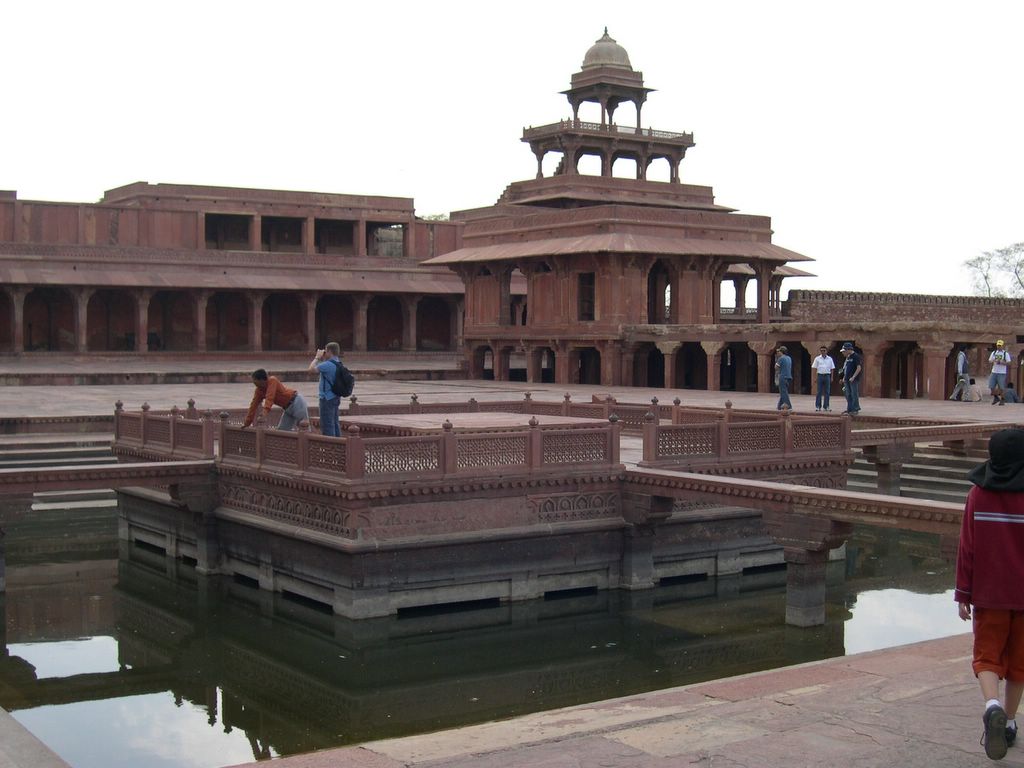
Inside the stone fort at Fatehpur Sikri. The place was built between 1571 and 1585 and is remarkably well preserved. Apparently it was deserted some 14 years after it was built as the mogul emperor decided to go back to Lahore. 
Day 229 - Further continued (The Taj Mahal and Fatephur Sikri, India - 23rd March, 2005)

We are on the train to Agra looking at the crapping out of the window (see posting below). We arrive in Agra, a pleasant but busy station at around 8:30 am. Now one of the best things about being an ex-pat is that you have people working for you personally who are willing to do extraordinary things just for you. Our driver Shashi (quite simply the best driver in New Delhi and perhaps the only person I have ever met who I would prefer to drive me other than me) had driven down (four hour drive) over night so that he could meet us, fresh and ready to go for the day. Some people send their baggage on ahead, we sent the driver.

As we strode out of the station I could see him gesticulating above the pandamonium around us. Porters trying to grab your bags, taxi drivers pushing you toward their cars and general "ne'er-do-wells" begging or pick pocketing or whatever they can do to get something from you. Our saviour rushed to our side and in his usual protective manner started to prise off the assorted persons who were trying to steal us away. He gently directed us towards the car, pompously parked in the middle of the station entrance as if the president himself was arriving. We certainly felt like we had arrived and we were hugely relieved that we didn't have to start finding a car to take us around all day.

Shashi drove off secure in the knowledge that he was now the driver to the most important visitors Agra and the Taj Mahal would have today. Other cars, rickshaws, 3 wheelers (motorised rickshaws) and pedestrians were simpy pushed off the road until we reached the main road and were settled into our journey to the Taj Mahal.

Shashi, previous to his employment with Rob's company (he has worked as Rob's private driver for 3 years now and Rob also has a company driver) was a long distance driver. He has intimate knowledge of the road network across most of India and he obviously knows all the places where white foreign visitors would like to stop. So within 20 minutes of arriving in Agra he gets us to the 5 star Sheraton Hotel for a cup of coffee (fabulous), a couple of croissants and a pee stop in an acceptable lavatory. This man is good and Julie and I will have to tip him handsomely for his endeavours when we leave India.

After our quick pee and tea break we are on the way to the Taj again. There is a man waving to us from the side of the road and Shashi pulls the car up to collect our guide. He had arranged for this man to be made available to us as he had used him to escort my Mum and Paul some weeks before and other members of our family on previous trips. He was the family's guide after all. We were begining to feel more and more like royalty.

It seems that wether you like it or not you have to be accompanied by a "guide" when you go to any of these attractions. He was not the most personnable of characters and started immediately telling us of the history of the building we were about to visit, as if we were on a school trip. We were cut off in mid flow if we dared to ask a question and our thoughts were prevented from wandering by his booming voice coming from the front seat of the car.

As a racket designed to maximise the amount of cash they get from you, all car and bus traffic is prevented from getting closer than half a mile from the Taj Mahal. Some balarney about exhaust fumes causing the Taj to rot and become discoloured or something like that. The problem is not the vehicular traffic in the area but the area of 3,166,414 sq klms around it called India. Acid monsoon rain from the big industrial and steel areas many many miles away are more likely to be the cause. Millions of gallons of raw sewage spewed into every river in India (and the one that passes next to the Taj is the Yamuna. This river flows (not really the right word, more like sludges) past New Delhi where it receives 3,296 million litres of raw sewage per day) creating all sorts of problems and the constantly lowering water table of the whole nation are more likely to be real threats to the building. Nevertheless, we pay a driver of a CNG (compressed natural gas) rickshaw to drive us the half mile up to the tombs gate.

The entrance fee to the Taj Mahal is uncharacteristically high for an Indian attraction. I think it was in the region of £9 each. This is a special price for foreigners, as Indians are allowed in for about a quarter of this. Fair enough I would say. There aren't any tourists that have found their way to the Taj Mahal that couldn't afford that kind of money. Security was pretty good too. You had to go through a metal detector and smile at a security guard and you were in - even if you did set the detector off.

When you go in the main entrance to the grounds of the Taj you cannot immediately see the building. You start in a courtyard sort of place and walk over to an arch on the right hand side. Then you get your first glimpse framed in this arch.

Seeing this building is like looking at a blindingly attractive woman over the otherside of the room. You are drawn to look but you don't want to make it too obvious to your partner and you don't want to embarrass yourself. But you cannot look away and you are constantly driven to look again and again just to see if your eyes aren't deceiving you. Quite, quite extraordinary.

The building looks like it is alive. It has a dazzling aura emanating across the skyline and literally grabbing your eyeballs. There is a point when it actually hurts to keep looking and this is not just because it is physically so bright that you need sun glasses to protect you. My brain could no longer compute, so the image of the building had to be rested from my eyes to prevent a complete burn out.

We had a perfect viewing day and our guide, who by now had told us the story of the Taj 3 times, was quiet, allowing us the moment to take it all in. He also seemed to be immune from the whistling grounds keepers, who were keeping people to the designated paths and he showed us across lawns and into "out of bounds" areas, with impunity, allowing me (so I thought) the priviledge of getting some of the best photo shots. Indeed I certainly got some unusual angles. I think he was interested in making us believe we where somehow special and extremely lucky to be with a guide who had access to these priviledged areas. His tip was uppermost on his mind I have no doubt (goodness me I am becoming so cynical!).

Some interesting things you might not know about the Taj Mahal:

1. The towers are built at an angle of a couple of degress away from the main building. The idea was that if they fell down (for whatever reason) they would fall away from the main tomb.

2. The Taj is a tomb to the Kings wife, Mumtaz Mahal, who died in 1631. I always thought it was a palace.

3. About 20,000 worked toiled for 12 years to complete the building in 1643. Some of the skilled craftsmen then had their hands or fingers amputated so that they would never again be able to build anything that would compare.

4. The calligraphy around some of the arches is bigger at the top than at the bottom (up to 20 feet from top to bottom). This creates the impression when you read it from the bottom that it is all the same size. A very clever little trick for the 1600s don't you think?

5. When the building was completed all that remained was for the scaffolding to be removed. Shah Jahan (the King) was informed by the architect that it would take another month to remove this and make it ready for his viewing. This was not acceptable to him. The King told the architect to tell the men they could keep any of the materials and scaffolding they removed from the site. It was cleared in a day. (Julie's favourite).

6. A site was cleared across the other side to the Yamuna river where the King was going to build an identical tomb in black. The black and white tombs were to be joined by a bridge across the water. Unfortunately the King was deposed by his brother before this could be started.

After much photography and quite alot of herding by our guide (who probably wanted to get our trip over and done with so he could start another) we eventually called it quits after about 2 hours. It was really all we could manage as just being in the presence of such beauty was quite exhausting.

When we got outside the main walls we had to find a rickshaw to take us back to the car park. Our guide was keen for us to take a motorised one (quicker) but we actually decided to walk and take in some of the atmosphere (stinky urinal smells all around). The boys who were complaining bitterly about being on their feet for more than 10 minutes persuaded us that they needed to take a covered cycle rickshaw. After all it was blindingly hot (perhaps 33 deg C) and they had been up since 5:30 am - the poor darlings.

So we all set off down the road back to the car and Shahsi. Some way after we had started Sammy decided he would like to sit on the saddle of the rickshaw as the driver was just pushing the thing down the road. He could not have peddled at the slow pace that we were all walking. After some time Sammy decided that it would be fun to sit on the saddle. This led to him riding the machine and finally asking the rickshaw driver if he wanted a ride back to the car park. We said we would only charge him 20 rupees. I have never seen an Indian laugh from the stomach before.

The guide had one more thing he wanted to show us. He had set up (this is how he put it) for us to be able to tour a marble factory where they were doing some intricate inlaid marble work. It would be extremely interesting. I realised straight away that this was a set up for another hard sell. The taxi drivers in Bangkok tried to get us to go to clothes shops so that they would get bonus petrol coupons. The guides here get you to go to "marble factories" so they get a bonus on anything you spend. You wouldn't mind so much if they were up front about it.

So we pull up at the "factory". All of a sudden the boys who were asleep on the front steps rush to their "factory" stations and pretend to be hard at work. The proprietor comes out being especially proprietorial and invites us to come and see his workers. They are now getting into their work again for the benefit of their new visitors. We got a run down on all the types of inlays and how it is all done. It even appeared that the "craftsmen" were genuine. Then came the hard sell. He took us through to the sales room which was crammed full of table tops, large dishes and vases all made with exquisite inlays on white marble, just like the craftsmen who built the Taj 400 years ago. There was nothing in the room that was under £100. I thanked him kindly but informed him that I was unemployed and had been for the last 8 months and that none of the white marble would be suitable in our house with 2 young boys tearing around.

No problem he replied, please just look at one more room. Just as you were about to leave he takes you to the upstairs sales room where all the items are priced from £10 to £100. Even an unemployed man could surely afford something in this room? The little elephants were quite cute but we have strict policies about collecting trinkets and rubbish souvenirs. We don't. I am sorry we are still unemployed and since walking up the stairs we still own 2 tearaway young boys. I hand him a 100 rupee note to share around his "factory boys" (knowing full well that they will never see it) but it allows me some dignity in our departure.

Shashi says we have to leave our guide behind now as he is taking us to another location. The guide is now looking to be paid. As is the case for quite alot of things, when you ask for a straight price you get some convoluted answer like; "You pay what will make you happy" or "If I am good you pay good, if I am not you do not pay". The bellwether for most of these dilemmas is that you ask Shashi the driver. He usually comes out with a figure that if proffered to the recipient would cause some offense. So we take his figure and multiply it by about 4 to get to a reasonable amount. At the same time making sure he doesn't actually see what you end up giving the person, as it would be an insult to him if you ignored his advice. (I hope you get the picture).

Julie and I both came to the conclusion that 500 rupees would be a good amount to pay him (about £6.50). All this money thing is really quite complicated. You want to pay him well. He knows that in his terms we are millionaires (a million rupees being about £12,500) and that whatever we give will really mean nothing to us in our terms. In his terms anything more that a hundred or so rupees for his 2 hours work puts him in the top percentile of wage earners in the country. Considering a station manager (one of the best jobs on the railways) would be getting about 50 rupees per hour. So there is this big chasm to cross and find middle ground where we don't think we are being ripped off ("you didn't pay 500 rupees for your guide surely - we got away with 300 on our trip" type of conversation back at the High Commission bar in the evening) and we are not being mean. We both thought 500 was the figure.

The problem is that invariably when you hand over the cash you get this blank puppy dog look that screams: "come on you miserable tourists punk, it's nothing to you - pay me a proper amount". They look at the money you have just handed over as if it's the smallest amount they have ever received in their entire working lives. We have had this kind of expression even when we have later learned that we overpaid by 10 times the norm. There is never, absoutely never, a smile and a gracious thank you for having just handed over enough money that they need not work again until next month. I'm sure it's cultural and I am making it all up and being very hard on them. But for their own benefit they should surely learn that a little graciousness and thanks would earn them better tips in the long run. I have often been tempted to give more but when I see this kind of response my heart hardens and I sub-conciously put the money away to give to someone more needy.

Shashi then drives us to a "westerners" Indian restaurant complete with a musician and dancing boy in the car park. This is just another attempt to persuade you into giving another tip. It's endless. You even have to tip the toilet attendant. The one at the stop on the way home was even rude enough to say to me that he only accepted notes after I had pulled out a handfull of coins to give him. Perhaps it was because I did not tip the toilet attendant (I had no further change or small notes) on my second visit to the toilet that we somehow ended up with a massive dose of "Delhi Belhi" after our visit to this restaurant. We shall never know for sure.

The meal was actually quite good. We had all the Indian usuals and Julie and I had a chicken masala. We think it was this that caused the problem for us. Our fellow traveller Valerie, who only ate the vegetarian dishes was completely unaffected.

After the meal and having had to run the gauntlet of the toilet attendant money grabber and the musican money grabber in the car park, we escaped back to the sanctuary of Shashi's car. He then drove us on to a place called Fatehpur Sikri. On the way we drove along the road where they have dancing bears. We saw 6 or 7 big bears the biggest of which was 7 foot tall. They originate from the Himalayas and have been dancing for tourists on this road for a 100 years. They are controlled by means of a metal ring through their noses that obviously causes them great pain if they resist. We never actually stopped the car to look but we drove along at just the right speed for Sammy and Julian to get a grasp of the incredible cruelty involved in this kind of activity.

Julie was able to read a few pages from an M.M. Kaye book (her first autobiography of her early years in India between 1910 and 1920) where the author had witnessed the same scence on the same road nearly 100 years before. Her father had told the bear owner that if the bear was not released the owner would end up with a ring through his nose being pulled around by the bear. Perhaps we should have tried that.

We arrived in Fatehpur to discover that we needed to have another guide. We totally ignored this one and he soon got the message that he was only needed to answer questions rather than to give us his spiel. This was quite frustrating for both us as he was often unable to answer my questions (which I admit are always of the obtuse type such as "how did they fix doors and wall to all these stone structures?") and for him we were obviously not going to be attentive customers who tipped him well.

This place is on the top of a hill and is a huge palace and fort built by the emporer Akbar between 1571 and 1585. It was the Mughal capital for 14 years and was constructed entirely of the local sandstone. As for many of these ancient monuments, this one too was protected and preserved by the British. This one by Lord Curzon, a legendary conservationist.

It was not as beautiful as the Taj Mahal but somehow, as it was a place where people lived and not a tomb, it held a great deal of interest to me. I was trying to imagine how they lived in these buildings. Of course there were no re-contructions or mocks ups of rooms and no drawings or artwork that would help explain any of this so you just have to have a good imagination. The guides are pretty useless if you are not asking about the history. I wanted to know about the operation of the place but was left wanting. It is a World Heritage Site and deservedly so.

After a fascinating visit we went across the car park to visit the mosque that had been created at the same time. It is one of the biggest mosques in India and had the highest gate in the country. As I was wearing shorts (how heathen of me) I was required to don a skirt in order to enter. We were also all required to remove our shoes. There was not really too much to see in here as it was a huge courtyard with only a couple of structures in it. One of these was a tomb contructed in the same manner and design as the Taj except that it was only the size of a 4 bedroom house. It was where one of Akbar's sages was buried.

By now we were looking at about 4 o'clock and we knew we had a 4 hour car ride home, so we hurried along and jumped back in the car. The journey back was long and quite tedious as some of the roads were extremely badly kept and the ride was very rough. We were also kept amused when it got dark, trying to spot things on the road that didn't have any lights. These included all rickshaws, ox and carts, camels and carts, people, overloaded tractors and a majority of cars whose lights were broken. Shashi seems to have been born with night vision googles attached to his retinas but I could only spot about half of them. There were several occassions when the car skidded to a halt or was violently jerked from one side of the road to another. I did say that Shashi was the best driver in New Delhi, which he is, but passenger comfort is not top of his list. So we arrived home in quite a state of shock, completely worn out and drained by trying to assimilate all that we had seen. A great day.


Sammy took control of this cycle rickshaw on our way back from the Taj Mahal. The driver was walking along with us as Julian and Sammy were pooped by now and needed to sit for a while (don't ask). After some time Sammy wanted to sit on the saddle. Then he started to pedal the thing. We eventually asked the driver if he wanted a ride back to the car park. We were prepared to take him, we said, for only 20 rupees. It's really the first time I have seen an Indian laugh from the stomach. Posted by Hello

Tuesday, April 05, 2005

Taj Mahal - Pollution Monitoring Equipment Report:

Whilst looking into this whole pollution thing at the Taj Mahal, I came across this classic Indian report on the progress of the monitoring of pollutants in the area:

Essentially an inspection was made of all the pollution monitoring equipment in Agra on May 19, 2000. All the equipment was found to be inoperable as they had no chemicals which were needed in the monitoring process. I quote:

The team found that none of the Air Quality Monitoring Machines were working. The Fluorescent SO2 Analyser Model 100A, API Incorp., the Chemiluminescent NOX Analyser - Model 200A bought through M/s. SICO, Delhi in July 1998, SO2 Analyser - D.K.K. (Japan) January 1981, Sl. No. 20810 lying in the room were not in working order at all. Mr. Gupta stated that for the first two machines the spare parts were not available and so these were not working since October, 1999. He stated that the third machine SO2 Analyser from Japan was shut since April, 1994. Hence, the analysing machines of two polluting gases which are crucial for the protection of the Taj, were not functioning. This means the ASI has no information whatsoever about the quantity and effects of polluting gases on the Taj.

The team then carried out an inspection of the Laboratory Stores available at the Monitoring Station. It found that the essential chemical solvents to do the analyses of polluting gases, even if the machines mentioned above are functioning, were not available. The probes for measuring the acid/alkali content of the polluting gases were absolutely dry, when the requirement is that these should be kept in water all the time. The Filter Papers for collecting the Suspended Particulate Matter (SPM) in the Air around the Taj through the High Volume Sampler (HVS) were also not available. There is the non-functional electrical balance available in the station. The filter papers are taken to the ASI Chemistry Laboratory located at Red Fort in Agra.

Even if, the machines on the roof top, the analysers in the room are functioning and the necessary materials like filters and solvents are available, still the Monitoring Station can not monitor the gases and dust that are known to be harmful for the Taj. This is so because there is no electricity available to the monitoring station, despite the orders of this Hon’ble Court. Further there is no backup system available to enable the machines and analysers to function.


Even if the machinery was in working order and the chemicals were present there is the little problem of no power. All the equipment in the world will do no use without power. Nobody thought about this. Bet your bottom dollar the situation is exactly the same today 4 years later.

The report goes on to say about the construction in the area. They discovered, contrary to all building regulations for the area surrounding the Taj, that buildings were being put up within 50 metres of the gates of the Taj. Further quote:

The team discovered two shocking facts of constructions in the immediate vicinity of the Taj less than 50 meters away from the Eastern Gate wall of the Taj. The first fact was the digging of four deep foundations with four R.C.C. iron rods beams ready for erection and pouring in of concrete. This prohibited construction in terms of the Union Govt. notification was going on right under the nose of the police picket stationed there itself. The team members rang up the SP City on his Mobile Phone No. 9837004521 to ask him about this digging and construction. He expressed complete surprise on being given this information. The Head Constable Mr. Ajaib Singh of the 15 Provincial Armed Constabulary A.Co., Agra, who is Incharge of the picket had no explanation for what was being done right in front of him.

It just doesn't get any better than this. You have to laugh. Then you think about the criminal damage that is being done. It makes me very poorly.

Monday, April 04, 2005

Monday, April 04, 2005

Day 229 - Continued (The Taj Mahal and Fatephur Sikri, India - 23rd March, 2005)

I was rudely interrupted with this blog as Julie and I were both struck down with "Delhi Belhi" and then we went away for a week to the mountains. But I will continue now ....

Julian and I ran for all we were worth towards the central area of the train station. There is simply no chance that I can describe this scene, as I simply don't have the words that would bring it to life but here are some of them; stinking hot, fetid aroma, semi-darkness, half a million people in one station, chaos, a thousand horns blaring. The heat, the smell and the crowds simply have to be experienced.

We got to the main area and started to look for a display that would give us a platform number for the train to Agra. For some reason that I still can't fathom, an official looking person asked us if they could be of any help. This is usually the sign to be extremely wary and in most cases these offers (which we have subsequently discovered, are not all insidious in nature) should be ignored. I asked which platform we needed to be on for the train to Agra. Immediately the reply came that it was platform one. Handily this was the platform nearest to us and did not require traversing any stairs or other barriers. We pushed our way forward (it helps to have good elbows in India) and made it to the platform and started looking for our carriage. By now I could see that we had at least 2 minutes in hand so I started looking for Julie, Valerie and Sammy. By luck they had also bumped into a helpful man who had directed them to the same platform and it was only about 30 seconds after we had arrived that they turned up. We found our carriage number and all jumped aboard. I think we were the last to arrive before the train departed a minute or 2 later. Slightly flustered, hot and bothered we had made it.

I just can't believe the trains here. We were left for hardly 10 minutes at a time before we were offered something to eat or drink or read. All the food, which included a full Indian breakfast and a snack at 11:00 am was included in the fare. We were on the top class express train but still the single fare for the 4 of us to Agra (300 klms and 3 hours away) was only about £20.

The journey south through the outskirts of Delhi is an appalling assault on the senses as you see mile after mile of slum dwellings fit only for pigs. It takes about half an hour on the train before you get into really rural community areas and even then you are again battered by the view, as you pass through smaller towns and cities with the same problems as Delhi.

India really is a massive toilet. This is not because I think so but because it us used as one by it's population. We were obviously travelling during the peak morning toilet period. Every piece of scrap land, roadway, culvert, rubbish dump and footpath had people on it crapping. With one look out the train window you could see up to 30 people crapping. With absolutely no sense of order or discipline, you simply find a spot where no one has been before and you crouch down and crap. Then you clean yourself off with your little tin of water. All in front of everybody and the passing Agra express. It really puts you off your breakfast.

This desire to perform your bodily functions in public is not only restricted to the slum areas on the outskirts of town. Men in the cities love to find the most prominent spots to wee in public. In the middle of the central reservation is my favourite but anywhere will do. There is not a moment in New Delhi when you can't see someone peeing. Some spots become well used over a period of time but you can never mistake where they are because the stench is overwhelming. Women, who I am sure, are required to expel the same amount of urine as men, are never to be seen performing in the city streets. I just don't know what they do and whatever it is, why can't the men do it?

I don't want to dwell on this any longer than necessary but dear reader it is necessary to get it off my chest. This "crapping anywhere" is apparently cultural. Of course most of the residents of the areas concerned don't have a house of their own, let alone a toilet. You have to go somewhere. But why crap so ardently on your own doorstep? We have been to some of the most famous places in India and as soon as you step off any main pathway you are confronted by human crap. Forget about dog shit, this is human crap and there is no poop and scoop.

In the simplest most primitive societies (since when was I an anthropologist?) I would expect there to be some form of crap control. How about; just dig a hole. It would take a couple of people a couple of hours to construct a privvy that would provide modesty and sanitation at virtually no cost. This simplest of tasks does not happen. Even in the poorest of shanty towns there is some semblance of order and cohesion in the communities. Why then can't they get it together on the sanitation front? I simply cannot believe that the whole country has not been struck dead by typhoid or cholera which can only be spread through direct contact with human feces.

Julie has been reading a book called "A Fine Balance" by Rohinton Mistry which tells of the story of four people who have to leave their rural existence in an Indian hill station and are plunged into living in a shanty town on the outskirts of a big city. The first thing they had to learn to do was to crap in public on the available wasteland. The book describes in great detail how foreign this was for them. They presumably had different arrangements in their village home. But it highlights one of the main reasons it exists. There has been a massive increase in population in the last 20 years (it has grown in this period by nearly half a billion and continues to grow at a rate of 50,000 per day or 18.5 million a year). Much of this population can no longer be supported and fed in the rural areas and there has subsequently been a massive exodus from countryside to city areas. There is probably less chance of becoming malnourished in the city where it is certainly possible to live off 15 to 20 rupees (20 pence) per day for food (we could feed our family easily on 40 rupees or 50 pence per day). This can be earned quite easily by begging, rubbish re-cycling (1 kilo of plastic re-cycling fetches 12 rupees from the recycler) or other menial tasks. Rickshaw (the pedal variety) drivers, who predominantly live in shanty towns, can earn about 100 to 150 rupees per day, which would be enough to support their families.

In the rural communities there has been much exploitation of one caste by another and many of the small community farmers have been driven out of business by having to pay extortionate interest rates of between 100% and 450% to borrow money from the local mobster to buy seed. Even then the farmers and agricultural workers will only earn on average 10 rupees (12 pence) per day ....

Other comments are just guesses and my own deluded and biased opinion about the state of this country. I am (if you had not already guessed) completely upset by it. I am a person who lines things up symmetrically on my desk. My pictures must hang straight. There is probably a psychoanalytical term for my condition (chronic pathological linearist?) but there is no known treatment for it. Therefore when you are in a country where everything is made off centre, out of true, with no alignment, no explanation or reason and not finished, it simply drives you insane. These rantings are therefore the result of this disease of my mind.)

Phew, here we are, we haven't even arrived in Agra yet and I am diverted onto an essay about Indian toilet habits! I think the longer we are away from home the greater necessity I have to blurt out at random. It seems to me that the observations are of more interest than the places. My readers probably do not agree but we shall see.

Anyway to get back to the point, we are on our way to Agra and I am going to continue this blog in another posting that will appear on top. This one is getting too big already.

Sunday, April 03, 2005


On a further expedition I managed to persuade Julie to go by horse. Having already experienced elephant as a means of transport, she was somewhat spoilt and reluctant to mount such an inferior beast. But for her first time on a horse, she did very well. This was no trot around the paddock. We climbed up paths of boulders that sometimes were at an angle of 45%. Coming down was precarious as the path was unsuited to metal hooved creatures. They often slipped and on one occassion my steed fell to his knees. It was a baptism by fire into the world of horse riding. The boys loved it. From left to right mounted: Julian, Sammy, Julie, Michael, Daniel, Me and Suzanne and Rob in front (click on images to enlarge). Posted by Hello

I reached the top of this 8,300 ft summit after an hour and a half on horseback. Julie and our driver Shashi (please don't call him Sashi) took a little longer as they walked. I tried to tell Julie it was way too far to climb but you can imagine what effect that had on her. She climbed 1,000 foot over a distance of 3 klms in 2 hours. From the top we should have been able to see the Himalayas but at this time of year it is too misty during the day. You can see the lake at Nanital just at the bottom of the flagpole. This is about 5 klms away and 2,000 feet below this lookout. All the boys also made it by horseback and Rob also walked up. Posted by Hello
Day 240 - New Delhi - Sunday 3rd April 2005

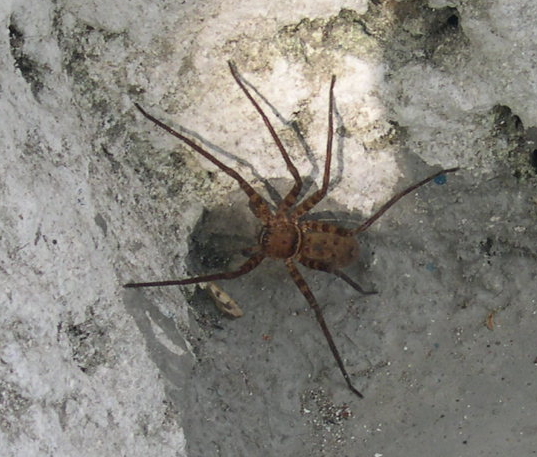
We are back from the foothills. All just about in good shape. Julie and I spent quite a bit of time on the toilet when we weren't being chased out of it by the worlds biggest and scariest spider (I later discovered it was called a Huntsman). But now I think we are almost fully recovered. I had my first beer in about 10 days yesterday and although I didn't really fancy it, I forced it down. I didn't have one today.

We arrived home yesterday evening after travelling back on the train from Kathgodam. Of the many things that the British did for this country during their governance of it, the Indian rail network is perhaps their greatest legacy. Today's network was almost entirely built under British management and it is still going. It is the largest employer in India and the world (1,583,614 employees in 1997 and is in the Guiness Book of World Records as the world's largest employer). In 2003 they advertised 22,000 jobs and received 740,000 applications.

The trains run almost on time, are ridiculously cheap (4 of us travelled 320 klm in six hours in air conditioned comfort for less than £10 total) and relatively comfortable for first class passengers like ourselves. Other folk are less well accommodated. Our journey took us through Moradabad (brass city where many Hugo Russell items used to come from) where we saw a train with people sitting on the roof. The carriages which are designated to carry 70 passengers (seated) would have had well over 300 people in them. We saw faces pushed hard up against the barred, glassless windows that would be imprinted with the pattern of the metal work when they were finally allowed to move. In between each carriage there would be 3 or 4 "passengers" riding the buffers and addition to the 3 or 4 people who weren't on the train but hanging from it at the doorway. The ticket inspector, who had been so fastidious about ticking off the first class passengers by name, would not have stood a chance. There was just no telling how many of these passengers had actually paid.